
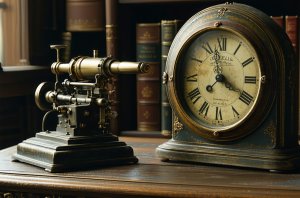
The Time Machine
By H G Wells
The following is part of a series exploring classic books for people who always meant to read them, but never quite got around to it.
Introduction
Hello and welcome. Today, we’re stepping into not just another book, but a universe of possibility — one that has inspired generations to dream, question, and wonder about the future of humanity. Our focus for this episode is The Time Machine by H G Wells, first published in 1895. Even now, all these years later, this slender little novel still stands like a doorway flung wide open, inviting us to imagine worlds far ahead of our own.
The man behind these astonishing pages, Herbert George Wells, was no ordinary storyteller. Born in Victorian England, Wells juggled ideas of science, society, and the shadows they cast over our future. He was part scientist, part philosopher, and entirely a spinner of tales that stretched the boundaries of fiction as people knew it. His works, including this one, laid the very foundation for what we now call science fiction.
Published right on the cusp of the twentieth century, The Time Machine isn’t just a tale about strange gadgets or fanciful journeys. It’s a pointed reflection on what it means to be human, why we strive, and what might become of us if we lose sight of ourselves and each other. The story’s questions still pierce through time: What happens when science outpaces wisdom? Where will our choices carry us across the centuries?
You may never have picked up this book, but its echoes can be felt everywhere — in films, in the very terms we use for time travel, and in our persistent yearning to peek around the corner of tomorrow. So, let’s embark on a journey that begins in a quiet Victorian drawing room and rides a clattering, mysterious machine far, far beyond our own lifetimes.
Settle in as we unravel the story of a man who dared not just to dream about the future, but to step into it. Who are the Eloi and Morlocks? What waits at the end of the world? Let’s find out together.
Story Summary
Our story opens on a gray evening in late Victorian England. In a small house near London, a curious assembly is gathering. You can picture the group: the Medical Man, the Provincial Mayor, the Psychologist, a few other gentlemen with distinguished titles and keen, skeptical eyes. They’re drawn there by the magnetic presence of their host, referred to simply as the Time Traveller — a thin, quick-witted man with restless hands and a mind that can’t seem to stay put in any one era.
The conversation that night turns to the subject of time. Not just the ticking of clocks, but time as a dimension — something as real and solid as the length, breadth, and depth of their own drawing room. Some in the company are amused, others annoyed, but all of them listen as the Time Traveller explains: “There are really four dimensions, three which we call the three planes of space, and a fourth, time.” He proposes, with unwavering confidence, that it should be possible to move in time, just as we move in space.
To prove his point, he unveils a tiny model of a machine. It’s constructed of gleaming nickel and ivory, with subtle levers and spindles. Before their eyes, he presses a lever, and the little machine vanishes — not flickering or darting out of sight, but slowly melting away as if passing into another plane of existence. The guests are dubious, but intrigued enough to return a week later for a more dramatic demonstration.
This time, the Time Traveller excuses himself and disappears into a side room, only to reappear some hours later, disheveled, limping, covered in dust and blood. The dinner is hardly touched before he beckons everyone into his smoking room to recount the strangest tale any of them — or us — will ever hear.
Here’s how the adventure unfolds as the Time Traveller shares his story, his voice trembling with excitement and a hard-earned hint of fear.
It began in his laboratory, mere hours before. After years of obsessive work, the Time Machine was ready at last. It was full-size now, brass gleaming, quartz rods pulsing, ivory levers inviting his touch. He recounts sitting astride the saddle-like seat, nerves fluttering but mind resolute. Then, with the push of a lever, reality shudders. All at once, the walls of his laboratory blur, the sun flickers overhead in a wild staccato, days darting past like the wings of startled birds. The air itself rushes with a peculiar sensation as he realizes that, in his machine, time is no longer an unchanging river, but a road on which he can travel at will.
He watches his house erode and rebuild itself, the garden turn wild then neat then wild again. Seasons flicker past, the city rises around him, and before long, centuries have collapsed in a dizzying whirl. The world outside grows unfamiliar, and he resolves to stop — landing, through careful manipulation, in an era far removed from his own.
He steps from the Time Machine into a world washed in wild, luminescent light. The year, by his reckoning, is more than 800,000 in the future. Flowers of impossible size and color blanket the land. Gone are the factories and smoke of his own day; here is a landscape gentle and serene, with ruins covered in creeping green and air sweet with the scent of foreign blooms.
Soon, he meets the first of the inhabitants: the Eloi. They are small, almost childlike creatures, graceful and beautiful, with cheerful faces and bright tunics. To the Time Traveller’s surprise, the Eloi seem curiously placid, lacking curiosity and ambition. He tries to learn their language and customs, only to find them distracted, like butterflies flitting from one pleasure to the next. Hunger and hardship, so common in his own age, are mysteries to them. The land is bountiful, the days are easy, but something feels off. There is a “strange childlike ease” to the Eloi, but also a fragile nervousness and a haunting absence of purpose.
The Time Traveller reflects that humanity, after all, has changed. The Eloi are the descendants of a once-industrious race, now softened and idle. Progress gave them comfort, but comfort gradually stole their strengths and their passions. “Strength is the outcome of need; security sets a premium on feebleness,” he muses. Looking at the Eloi, he wonders if unchecked civilization might eventually rob us of our grit and spirit.
His musings are interrupted by trouble. The Time Machine, left somewhat hidden in the long grass, has vanished. It’s not destroyed or broken — just gone, leaving not a trace behind. Panic grips him: is he stranded, lost forever in a foreign world? The Eloi are unable or unwilling to help, offering only vacant smiles and gentle pats. Their innocence suddenly feels threatening; the Time Traveller is alone, truly now, in a future untouched by his own time’s values.
He begins to search, observing the surroundings more carefully. One structure catches his eye: the great, ancient Sphinx, imposing and enigmatic, its face unblinking over the land. Close by, he notices strange wells, circular, with metal lichens clinging to their sides. Peering inside, he catches fleeting glimpses of movement, and hears odd mechanical sounds echoing from the deep. The surface world may be soft and bright, but there are shadows beneath.
Gradually, he encounters the Eloi’s other — darker — counterparts: the Morlocks. These are pale, furtive beings, with large eyes reflecting the darkness of their underground world. It is the Morlocks, he soon realizes, who have taken his Time Machine into the depths below. The Morlocks emerge only at night, their sensitive eyes keener in darkness. The Time Traveller surmises something profound: humanity, over the millennia, has divided. The Eloi inhabit the surface, idle and cared-for, while the Morlocks toil in the tunnels beneath, running unseen machinery and emerging only for food or maintenance. Over time, class divisions have warped into evolutionary divides.
More chillingly, the Morlocks prey upon the Eloi. In quiet moments, the Time Traveller describes his horror upon realizing that the peaceful Eloi are livestock for the Morlocks — pampered and protected on the surface, but seized in the night for nourishment. He reflects, “I understood now what all the beauty of the Over-world people covered. Very pleasant was their day, and their lives so frail and brief, running lightly and easily among the flowers; but … a prey to those dreadful creatures of the night.”
The Time Traveller becomes friendly, even protective, toward one Eloi in particular: Weena, a gentle, trusting girl who grows attached to him after he saves her from drowning. Weena clings to him, offering a fragile kind of companionship in this world stripped of meaning and family. Her innocence, though a comfort, is also a reminder of just how far humanity’s spirit has slipped.
Determined to retrieve his Time Machine and return to his own time, the Time Traveller must venture underground, into the Morlocks’ lair. The descent is terrifying: the air is chill, the stone slick with ancient moisture, and the smell of the underworld is overpowering. At first, the shadows flicker with movement; he’s not alone down there. The Morlocks surround him, their eyes reflecting pale light. With matches from his time and whatever courage he can muster, he fends them off, groping through eerie galleries where ancient machines grind without purpose and the bones of the Eloi haunt the corners.
Above ground, the Time Traveller searches for a way to open the bronze panels of the Sphinx, believing his machine lies within. All the while, he faces new obstacles. The nights become more dangerous, the Morlocks ever bolder in their attacks, and the Eloi growing more frightened and helpless. With Weena at his side, he flees one night through a dense forest, lighting matches and torches to hold back the pale pursuers. In a moment of overwhelming exhaustion and terror, a fire rages, the night becomes a chaos of flames and shrieks, and Weena is lost to him forever — another innocent claimed by this broken world.
The next day brings a final stroke of luck mixed with desperation. Returning to the Sphinx, he finds the bronze doors left open — a trap, no doubt, but his only hope. Inside, he discovers his Time Machine, battered and surrounded by Morlocks. Fumbling in terror, with the fiends clawing at him, he finally activates the levers and hurtles away, his mind reeling with sorrow and relief.
But his journey doesn’t end here. Disoriented, he finds himself drawn further and further forward in time. The sun grows harsher, the land barren and silent. Here is the far future: seas sluggish and thick, strange crab-like monsters skittering across crimson sands, the air stilled, and the sky faint with the distant glow of a dying sun. The world is ending. All is silence, save for a soft, ceaseless lapping of the dark ocean. He has reached not just the end of humanity, but the end of Earth itself. His heart heavy, he returns at last to his own time, the sights and horrors of the future etched forever into his mind.
Back in that quiet Victorian home, the Time Traveller finishes his tale. His guests, minds spinning, don’t know what to believe. Is he a visionary, a madman, or the first true explorer of time? Only the Narrator, quietly moved by the earnestness and sadness in the Time Traveller’s eyes, lingers behind. He asks quietly whether the story was truth or fiction. The Time Traveller doesn’t answer directly, but takes up some knickknacks — two strange white flowers, given to him by Weena — and places them upon the table. For a moment, the cynical twenty-first century reader might pause, too. After all, what proof do we need? What proof do we even want?
The next day, the Narrator returns to find the Time Traveller preparing to depart once again, planning to venture forward — perhaps this time, to bring back clearer answers or more tangible relics. He steps into the machine and vanishes, lost to history, leaving only questions and a quiet, lingering sense of awe.
That is where the tale closes for us, with a hush that stretches across the years and a story that won’t quite let go. Each of the characters returns to their daily lives irreversibly changed — as, perhaps, are we, for having glimpsed a possible future shaped by our present choices.
Reflections and Themes
The Time Machine is much more than a fanciful adventure or a technical curiosity. Beneath its surface lies a deep well of reflection on humanity — where we’ve come from, where we might be heading, and what it means to truly progress.
Wells, in his time, was watching an England bustling with invention and confidence. Technology and industry seemed poised to answer every question, solve every hardship. But Wells saw shadows behind the optimism. His vision of the Eloi and Morlocks is not just a flight of fancy, but a sharp warning about what happens when societies pull apart. The Eloi, for all their beauty, are soft, incurious, and defenseless. Their world is pleasant, but hollowed out — a paradise without striving, courage, or connection. The Morlocks, by contrast, are brutalized, creatures of ceaseless labor, living underground and preying on their former masters. It’s Wells’ commentary on the consequences of unchecked class division, where luxury and toil split humanity in two, neither side whole or healthy.
Wells dives deeper, too, into the nature of progress and the double-edged sword of civilization. At first, the Time Traveller dreams that the future will be a utopia crafted by enlightenment and invention. But as he finds instead, “Even in this world of leisure and plenty, the seeds of decay are sown.” The Eloi have forgotten the trials that shaped them, and lost something essential in the bargain. The Morlocks, forced to survive underground, become monstrous in turn. It’s a caution about comfort, about giving up challenge for ease, and what might happen if we lose sight of our own responsibilities to each other and to the future.
One quote near the end might stay with you: “I grieved to think how brief the dream of the human intellect had been. It had committed suicide.” Wells is recognizing that the spark of curiosity, of questioning and striving, is what truly drives humanity forward.
There’s also a profound loneliness that underpins the story. The Time Traveller’s journey is grand, but he’s isolated by his unique vision and ambition. He’s a man out of time everywhere he goes, misunderstood in both his own era and the future he visits. Weena, the gentle Eloi who befriends him, offers a fleeting touch of warmth, but is lost forever in the chaos. The flowers she gives him serve as a slender reminder that even in the bleakest future, there is room for trust, kindness, and memory — however brief.
For readers today, especially for those who have witnessed dramatic leaps in technology and society, Wells’ warning and wonder feel freshly relevant. Are our innovations truly for everyone, or do they risk widening divides? What pieces of our spirit must we safeguard as life grows easier in some ways and harder in others? Can comfort ever replace courage, curiosity, or heart?
Finally, the book leaves us with more questions than answers — and that’s part of its lasting magic. What matters most as centuries pass? What world are we helping to build, just by the small choices we make? In Wells’ futuristic landscape, everything changes but these questions linger, suspended in the hush at story’s end.
As you reflect on The Time Machine, you might find yourself searching out glimpses of your own past and future, seeing the threads that connect your life to those who will come after. What kind of world are we preparing to leave behind? Are we building only comfort, or something more enduring?
Closing
So, as the last echoes of this journey drift into silence, you can imagine the Time Traveller’s machine shimmering into the unknown, always a few moments ahead, always questing. Reading — or listening — to stories like this, we’re reminded that curiosity doesn’t fade with age, and that some of our most important explorations are not behind us, but always ahead.
If you’ve ever wondered what lies beyond, behind, or just out of sight, The Time Machine offers not only the thrill of discovery, but also a gentle caution. We are, all of us, time travelers in our own way, each day stepping forward into an uncertain future. Wells leaves us with an invitation: to notice the world, to question what we value, and to find meaning in each fleeting moment, whether grand or small.
This story, first published over a century ago, still opens the mind to wonder and possibility, and reminds us that every era holds its own mysteries. Wherever you find yourself in time, may you keep that spark alive — the urge to explore, to imagine, and to care for both the future and the past.
This has been The Book You Never Read — the story you always meant to read, now you have finally caught up.
About This Book
- Author description: H G Wells was an English novelist, historian, and social critic, widely credited as a founding figure of modern science fiction.
- Source: The Time Machine by H G Wells, available at https://www.gutenberg.org/ebooks/35