
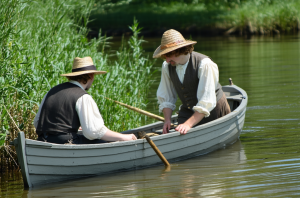
Adventures of Huckleberry Finn
By Mark Twain
The following is part of a series exploring classic books for people who always meant to read them, but never quite got around to it.
Introduction
Hello and welcome. Today, we’re stepping into the sun-dappled world of the Mississippi River—into the heart of one of America’s most enduring tales: Adventures of Huckleberry Finn by Mark Twain, first published in 1884. If the name rings a bell but the details escape you, you’re not alone. For generations, Twain’s story has echoed in school reading lists, classic film adaptations, and the background of American culture, always present but often set aside, waiting for that “someday” to arrive.
Mark Twain—born Samuel Clemens—wrote this novel during a complicated, changing period in American history. The Civil War had ended only two decades earlier. Twain drew from his own Missouri upbringing, interweaving memories, tall tales, dark truths, and the voices of the 19th-century South. His sharp wit and easy way with words stick with us even today.
But why, more than a century later, should you give time to Huckleberry Finn? This novel isn’t just an adventure for boys—it’s a winding, often surprising journey through the big questions of conscience, freedom, and what it really means to do the right thing. Twain’s writing reaches through the years with a liveliness and candor that still feels fresh, inviting us all to reflect on where we stand—both on the world’s big, muddy rivers and inside our own hearts.
So let’s lace up our imaginations and set off with Huck, raft-bound and curious, down the grand river of this American story—a book that promises more than meets the eye. Have you ever wondered how a runaway boy and a fugitive slave ended up sharing one of the most famous journeys in literature? Let’s find out together.
Story Summary
Let’s step into St. Petersburg, Missouri, a fictional backwater town, not so different from the one Mark Twain himself knew as a boy. Huckleberry Finn, known to all as Huck, is the son of the town drunk. He’s already had an adventure or two by the time our story picks up—having appeared before in Twain’s earlier novel, The Adventures of Tom Sawyer. But if you haven’t met him yet, you can picture Huck as restless, practical, and wary of most adults.
At the start, Huck is somewhat reluctantly living with the Widow Douglas and her sister, Miss Watson. They’ve taken it upon themselves to “sivilize” him, as Huck puts it—teaching him manners, giving him clean clothes, sending him to school. But for someone used to freedom—sleeping outdoors, fishing for breakfast, avoiding his drunken father—this civilized life feels cramped and uncomfortable. “The Widow Douglas she took me for her son, and allowed she would sivilize me,” Huck grumbles. Still, he tries to play along, at least on the surface.
Alongside Huck is Tom Sawyer, his imaginative friend. Tom lures Huck and the other boys into make-believe adventures, inventing rules and codes, forming “robber bands,” and drawing from all the adventure tales he’s read. Yet beneath the boyish fun lies the real trouble that’s about to upend Huck’s routine. Huck’s alcoholic father, “Pap”, reappears in town, wild-eyed and angry to discover that Huck has a bit of money—rewards left over from past adventures with Tom. Pap wants that money for liquor and will stop at nothing to get it. The courts hesitate to take parental rights away, so Pap seizes Huck and takes him across the river to a ramshackle cabin, keeping him locked inside, cut off from everyone.
Huck’s life with Pap is harsh, sometimes frightening. The woods outside are beautiful, but Pap’s beatings, rants, and threats leave Huck desperate. Eventually, Huck hatches a plan. Using brilliance born of necessity, he fakes his own murder—slaughtering a pig to stage a bloody scene before slipping away in a stolen canoe. Huck is now presumed dead by the townsfolk, leaving him free to shape his own fate for the first time.
He makes his way to Jackson’s Island, a leafy, isolated patch in the river. Here, Huck intends to savor his freedom and avoid being found. One night, though, as Huck creeps among the trees, he discovers he’s not alone. He stumbles across Jim, Miss Watson’s enslaved man, who has run away after hearing he was to be sold down the river to New Orleans—an unthinkably frightening future. Jim’s running isn’t only for his own freedom, but for a chance to someday buy back his wife and children.
At first, Huck is startled. Jim was like family at the Widow’s house. Now, the two find themselves united—both considered fugitives, both in hiding on Jackson’s Island. Huck could easily give Jim up, but from this moment forward, their fates are linked. Huck agrees to keep Jim’s secret, and the two share days of contentment on the island—fishing, talking, cooking, and watching the river glide past. Still, the outside world presses in. After a near-discovery by nearby searchers, they slip away by night on a raft—making a pact to head down the Mississippi toward freedom in the free states.
From here, the story widens into a journey that’s both thrilling and full of risk. The raft becomes their home. By moonlight, the river shines; by day, they drift, hiding when needed. Huck learns raft-life quickly, and Jim—resourceful, superstitious, tender—becomes both companion and protector. As Huck tells us, “We said there warn’t no home like a raft. Other places do seem so cramped up and smothery, but a raft don’t. You feel mighty free and easy and comfortable on a raft.”
Their journey is filled with meetings, mishaps, and brushes with danger. Storms batter them. Once, they’re separated by a dense fog, each fearing the other is lost. But always, Huck and Jim reunite, sharing relief and the simple warmth of friendship. They tell stories, look up at the stars, and talk about everything—past, future, and the meaning of freedom.
Their plan is to reach Cairo, Illinois, where the Ohio River meets the Mississippi. Once in the free states, Jim can be safe. But fate has other ideas. The river’s shifting currents, thick night mists, and bad luck take them past Cairo in the dark. Now, the journey grows longer, more complicated, and more dangerous. Every city and town they pass through introduces a new set of faces—some kind, many cruel, and some with their own desperate secrets.
In one small town, Huck dresses as a girl to sneaky information and narrowly avoids exposure by fumbling with a needle and thread. Another time, he stumbles into a deadly feud between two wealthy families, the Grangerfords and the Shepherdsons—an endless, pointless cycle of violence. The Grangerfords take in Huck, charmed by his cleverness, but the feud soon erupts into violence, leaving many dead and Huck shaken to the core. He returns to Jim, deeply moved by how much he’s missed, and needed, their cramped corner of the raft. “I never felt easy till the raft was two mile below there and out in the middle of the river,” Huck remembers.
But perhaps the most memorable—and troubling—part of the voyage comes with the arrival of two conmen who join Huck and Jim on the river. These men, calling themselves the Duke and the Dauphin, claim noble foreign titles but are little more than grifters, looking to cheat or swindle wherever they go. Huck keeps an eye on them, knowing something isn’t right, but he and Jim have little power to get rid of these exploiters. Soon, they’re caught up in the Duke and Dauphin’s schemes—putting on fake plays, running scams, and even impersonating the long-lost brothers of a recently deceased man in order to claim his inheritance.
The town mourning the man, Peter Wilks, is immediately suspicious, but the Duke and Dauphin can be convincing. Huck, caught in their plot, is tormented by the faces of the dead man’s grieving nieces—especially kind Mary Jane. Eventually, his conscience pricks him so deeply that he decides to right the wrong. “I says to myself, this is another one that I’m letting him rob her of her money—and when she’s so kind to me, and so good,” Huck reflects. Despite the personal risk, he finds a way to warn her and expose the fraud.
During all this, the Duke and Dauphin continue endangering Jim’s tenuous freedom for their own benefit. They ultimately betray Jim—selling him as an escaped slave for a cash reward in Pikesville, devastating Huck. Now, Huck faces his greatest test: whether to follow the rules of his society, which teach that helping a runaway slave is wrong, or to act according to a deeper, more personal sense of right and wrong.
This struggle becomes the novel’s emotional heart. Huck agonizes over what to do—he writes a letter to Miss Watson to inform her of Jim’s whereabouts, believing it’s his duty. But holding the letter, thinking of their shared dangers and Jim’s unwavering loyalty, he has a revelation: “I took up the letter and held it in my hand. I was a-trembling, because I’d got to decide, forever, betwixt two things, and I knowed it. I studied a minute, sort of holding my breath, and then says to myself: ‘All right, then, I’ll go to hell’—and tore it up.”
It’s a brave, life-changing moment. Huck decides to risk everything for the sake of his friend. He sets off to help Jim escape, no matter what consequences may come.
To do so, Huck sneaks into the plantation where Jim is being held, only to find Tom Sawyer’s family visiting nearby. Through a sequence of confusion and mistaken identities, Tom becomes part of the rescue operation, relishing the chance to turn Jim’s prison break into a grand, elaborate adventure, much like those invented games of their childhood.
Tom’s plans are full of unnecessary danger—digging tunnels, baking secret notes into pies, sending anonymous warnings. Huck goes along, a little bewildered but determined to help. The night of the escape, chaos erupts. Shots are fired, Tom is wounded, but the boys and Jim bolt for freedom. Still, Tom insists on revealing everything to the household, unable to resist a dramatic conclusion.
At last, the truth comes out. Miss Watson has died and, in her will, set Jim free. Jim is now a legally free man. The heavy burden of Huck’s moral dilemma suddenly lifts. Tom, ever the actor, admits he knew all along that Jim had been granted freedom, but kept it secret for the thrill of the adventure.
Relief mixes with confusion and, perhaps, a touch of anger at so many needless risks. Huck is left to reflect on everything—on Jim’s loyalty, Tom’s carelessness, and the meaning of the whole journey. Jim, at last, is rewarded for his patience and courage—reuniting with his family, thinking about a future chosen by himself.
Huck, for his part, is changed by the experience. He has seen the best and the worst in people: innocence and cruelty, compassion and hypocrisy. The river—supposedly the easiest escape—has been a testing ground for the soul, shaping him into someone who thinks for himself, trusts his own heart, and questions inherited ways.
The novel ends not with fanfare, but with Huck planning to “light out for the Territory”—heading west, outside the reach of civilization, unwilling to be “sivilized” again. His journey continues, not on the raft, but in a quiet, personal search for freedom of another sort.
Reflections and Themes
Let’s pause for a moment and take in what Adventures of Huckleberry Finn leaves us, all these years later.
At the center is the question of what it truly means to do right—not by law, not by custom, but by your own hard-won conscience. Huck’s decision to help Jim, even at the cost of eternal damnation in his eyes, speaks volumes about the struggle between learned prejudice and natural kindness. His moment of clarity—“All right, then, I’ll go to hell”—is one of the most quoted in all of American literature, and not just for its punch. It’s a window into that leap that sometimes must be made when doing good goes against the grain of everything you’ve been told.
And what a pair these two runaways form. Jim, so often misunderstood or dismissed by the people they encounter along the river, is shown here in all his humility, generosity, and genuine humanity. His longing for his family, his warmth to Huck, his measured wisdom—these break through the backdrop of a world blind to his personhood. Jim, for instance, quietly reminds Huck of his own pain and dreams, teaching by example what patience and quiet strength look like when faced with constant threats.
Along the way, Twain laces the narrative with humor and satire. Almost every place Jim and Huck land features a fresh absurdity, a new critique of hypocrisy: parents who feud but pray in the parlor; conmen posing as European nobility in rural America; supposedly genteel folk condoning cruelty. Twain lets us laugh—sometimes wryly, sometimes outright—at the ways adults twist themselves in knots to avoid facing uncomfortable truths.
For readers and listeners today, Huck and Jim’s story is as much about the search for home as it is about escape. The river itself is both a highway and a haven—a winding opportunity for what could be. Yet, for all its freedom, the world they drift through is far from free. Jim’s flight is permanent, desperate, and always on the brink of disaster; Huck’s own flight is in defiance of society’s expectations and his own family’s failures. The yearning for dignity and self-determination runs through both their stories.
Twain’s attitude toward race, slavery, and morality is sometimes raw, sometimes satirical, sometimes tragic. For modern audiences—especially for older adults reflecting on a lifetime’s worth of changes—it’s a chance to look at how much, and how little, has changed. Huck’s journey asks: when have you dared to trust your own sense of right and wrong, even when it meant standing up against the crowd? How do we look upon those who are different, and how do we allow fear or comfort to guide us?
The language of the novel, its dialects and casual speech, can feel tangled for those new to Twain. But listen a bit closer, and you’ll hear a genuine variety of voices, full of music, sadness, and deep longing.
At heart, Adventures of Huckleberry Finn is about growth and empathy—about realizing the “other” is a person, with hopes as real as yours. The novel provides laughter and suspense, but its legacy is that of a river journey taken side by side, through the dark and the light. “Human beings can be awful cruel to one another,” says Huck. And yet, through Huck’s choices and Jim’s steadfastness, there’s hope for something gentler.
It’s a story that, once traveled, stays with you—just as the great Mississippi keeps flowing, shaping whatever it touches in quiet, unhurried ways.
Closing
We’ve spent our time tonight adrift in Twain’s world—with a clever boy and a wise, gentle man steering a raft through fog, moonlight, storm, and surprise. No matter how many times people have claimed to outgrow this novel or pack it away as a relic of school days, its questions and spirit feel ageless. Whether you’re drawn to the adventure, the friendship, or the deep challenge at the heart of Huck’s story, this book rewards curiosity with wit, heart, and more than a touch of mischief.
Perhaps, after listening, you’ll find yourself looking with fresh eyes at the rivers—both real and imagined—that have run through your own life. What choices have you made because they “felt right” in spite of what the world seemed to demand? Have you known friendship that crossed boundaries, or taken risks for a good cause? Twain’s quiet confidence is that the journey matters, and that the journey of understanding others never quite ends.
Whatever paths you’ve traveled, whether plotted by maps or wandered by instinct, there’s always room for another story—one where courage, humor, and kindness win the day, or at least make the journey a little brighter.
This has been The Book You Never Read — the story you always meant to read, now finally caught up.
About This Book
- Source: Public domain text from Project Gutenberg — Adventures of Huckleberry Finn by Mark Twain, available at https://www.gutenberg.org/ebooks/76
- Author description: Mark Twain (born Samuel Clemens) was an American humorist, lecturer, and writer, celebrated for his wry wit and profound insights into the quirks of human nature and American society.