
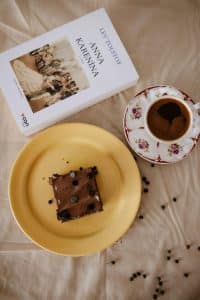
Anna Karenina
By Leo Tolstoy
The following is part of a series exploring classic books for people who always meant to read them, but never quite got around to it.
Introduction
I am delighted to welcome you as we step into the world of Anna Karenina by Leo Tolstoy – a novel first published in 1877 and still considered one of the greatest works ever written. You might recognize the name, even if you have never dived into its nearly nine hundred pages. Tolstoy’s Russian masterpiece is many things at once: a sweeping romance, an exploration of family and betrayal, and an evocative portrait of a changing society.
When Tolstoy began work on this story, he was already famous for War and Peace. But with Anna Karenina, he created a new kind of novel. It moves with the seasons of life and emotion, following not only the passionate and doomed Anna, but also an entire cast of characters navigating love, duty, doubt, and hope in Imperial Russia.
What makes this novel endure? For one, its humanity. Anna’s struggles, choices, and heartache feel immediate and personal, even today. Readers of all backgrounds can find themselves among the cast. The novel is famed not just for tragedy, but for its insight – its laser-sharp look into marriage, morality, and the risks we run for happiness. Tolstoy once called it “a novel about family,” and in many ways, every scene wrestles with tiny, everyday questions just as much as grand, universal ones.
You certainly do not need to memorize Russian names or marvel at nineteenth-century train schedules to enjoy this story. Let’s journey through foggy Petersburg streets, sunlit country estates, the dazzling world of balls and opera, and into the very private hearts of its people. By the end, you may still be debating exactly who is to blame, and what happiness costs. If you have always wondered what truly happens to Anna Karenina – and why her story matters so much, even now – this is your chance to finally understand why the novel is so deeply beloved, debated, and re-read.
Let’s set off, and see where Anna’s path leads us.
Story Summary
Let’s begin on a chilly winter morning in Moscow, in the household of Stepan Arkadyevitch Oblonsky. Everyone in the house is grumpy, the children are frightened, and Stepan’s wife, Darya Alexandrovna – known as Dolly – is weeping behind closed doors. Stepan has been caught in an affair with the children’s governess. For him, it was nothing more than a passing fling, but for Dolly, it is a world shattered.
This is not a story about Stepan, but his troubles set everything in motion. Word of the scandal travels quickly, and Stepan telegrams his unmarried sister, Anna Arkadyevna Karenina, in St. Petersburg, asking her to come help mend things. Anna, beautiful and respected, is married to the much older Alexei Alexandrovitch Karenin, a high-ranking government official. She is known for her charm and intelligence, and she travels to Moscow hoping to help her brother, but not realizing that her own life is about to be upended completely.
Let’s pause among the snow and anticipation at Moscow’s train station. Anna steps off the train – strikingly lovely, a woman “full of life and radiance.” At the same platform waits Countess Vronskaya, accompanied by her handsome son, Alexei Vronsky, a young officer, charming and searching for meaning. Through a series of introductions and happenstance, Anna and Vronsky’s eyes meet, and something electric sparks between them. Tolstoy writes, “He could not have explained what had happened, but at that instant, when he looked at her, something strange and unlooked-for was happening in his soul.”
But Anna does not come to Moscow for romance. She meets with her brother and Dolly, urging them toward forgiveness and reconciliation. She is warm and gentle with Dolly’s children and helps to bring some measure of peace back to the Oblonsky household.
Meanwhile, another story is unfolding. Konstantin Dmitrievitch Levin, an earnest country landowner and a friend of Stepan, arrives in town. He has come with one clear hope in his heart: to propose marriage to Kitty Shcherbatsky, Dolly’s younger sister. Levin is awkward, sensitive, deeply devoted to his country farm, and hopelessly smitten with Kitty.
Kitty is, however, caught up in fantasies of her own. She is dazzled by the attention of Count Vronsky, misunderstanding the superficial flirtations for something deeper. When Levin proposes, Kitty gently refuses him, expecting that Vronsky will soon ask for her hand. Levin, embarrassed and heartbroken, withdraws to his countryside estate to nurse his wounds and immerse himself in work.
The dance of love and longing continues at a glittering ball. Anna attends with Kitty and Dolly. Vronsky is there as well, and though expected to court Kitty, he is increasingly drawn only to Anna. As Vronsky and Anna take to the dance floor, Kitty realizes, painfully, that her hopes were misplaced. Anna, too, is shaken by the intensity of Vronsky’s attention and the feelings stirring within her.
After her stay in Moscow, Anna returns to her home in St. Petersburg and her husband, Karenin. She is determined, at first, to sweep away her errant feelings for Vronsky, to return to respectable married life with her son Seryozha. Yet Vronsky follows her to Petersburg, and before long, their mutual attraction becomes impossible to deny. On the other side, Kitty falls into a period of illness and depression, aware now that her own illusions about love have crumbled. For Kitty, it’s a time of deep self-examination.
You can almost imagine the overlapping circles of society gossip, as Petersburg whispers swirl. Anna and Vronsky begin a secret affair. Anna is caught between rapture and guilt, torn between her devotion to her son and the thrill of forbidden love. Vronsky, for his part, is consumed with Anna, heedless of consequences or his former prospects.
At first, Anna tries to maintain the appearance of normal married life, though Karenin senses that something is amiss. He is a man cold and formal, guided by routine and public perception more than personal warmth. Karenin first seeks to ignore rumors, but as Anna’s behavior becomes more erratic, he insists she refrain from public displays. Anna, emboldened by love, finds herself unable to comply.
Soon, Anna becomes pregnant with Vronsky’s child and confesses the affair to Karenin. The fallout is explosive but remarkably restrained – Karenin is devastated, but refuses a divorce, preferring to preserve the appearance of family. Anna is caught in an emotional wasteland: unable to leave her marriage without losing her son, unable to stay without dying inside. Tolstoy captures the wrenching agony with raw lines: “She did not know herself what she feared, what she desired.”
Around this main drama, the other characters keep moving. Levin, away in the countryside, throws himself into land reforms and farm work, trying to find meaning and solace. He is fascinated both by the rhythms of rural life and by the philosophical questions tormenting him about faith, death, and human happiness. Dolly, meanwhile, keeps her large family together as best she can, her hurt never fully healing but acceptance settling in over time.
Let’s turn to Kitty for a moment. Her path leads her abroad to a German spa, seeking recovery from sorrow and ill health. There, she matures and gains a deeper perspective on herself and the people around her. She helps care for a dying woman, finding compassion and purpose in small acts, and in time, she encounters Levin once again.
Anna’s life, by contrast, becomes ever more complicated. She and Vronsky travel abroad briefly, seeking escape, but happiness proves distant. Anna gives birth to a daughter, Anna (Annie), and nearly dies in childbirth. As she hovers near death, Karenin is moved by pity and forgives both Anna and Vronsky. For a brief moment, all three are united in sorrow and mercy, but the reprieve is short-lived. Anna recovers but the relationships cannot go back to what they were.
Vronsky, meanwhile, attempts suicide in despair at the seemingly hopeless situation, but survives. Anna finally leaves Karenin for Vronsky, living with him as a couple but outside the boundaries of society. They wander through Europe, but Anna’s heart aches for her son Seryozha, who remains with Karenin in Petersburg. Deprived of the right to see her child, Anna’s sorrow deepens. The more Anna is shunned by society, the more isolated she and Vronsky become from the world and even from each other.
Back in Russia, Levin and Kitty reunite. Levin’s proposal this time is accepted, and theirs becomes a story of quiet, imperfect, but deeply felt love. Their wedding is detailed with all the awkward charm of two people finding their way together. Kitty becomes the anchor in Levin’s life, supporting him as he wrestles with existential doubts, the toils of managing the estate, and his keen sense of responsibility for those in his care. Levin’s story, often quieter than Anna’s, is filled with questions about what makes a good life. Tolstoy describes him as a man “yearning for faith, but unable to believe.”
Anna’s situation deteriorates further. She and Vronsky return to Russia, settling in the countryside and briefly enjoying peace and happiness. However, Anna remains tormented by her separation from Seryozha and by her ambiguous social status. She begins to suspect Vronsky’s affection wavers, plagued by jealousy and insecurity. Their relationship sours amid quarrels and misunderstandings – the very passion that once sustained them now becomes a source of pain.
On his side, Vronsky pours himself into country life and later in military and civic projects, seeking respect in a world that has shunned Anna. But nothing seems to fill the void. Anna grows increasingly paranoid and desperate, feeling abandoned, “She saw in everything the proof that everything was lost, that there was no hope.” In contrast to Levin and Kitty, whose love, however imperfect, grows more rooted and mutual over time, Anna and Vronsky seem ever more unable to support each other emotionally.
Let’s pause for a moment and step into Anna’s own mind. Tolstoy shows us a woman torn in countless directions – her longing for happiness, fear of the world’s judgment, her guilt and yearning for her child, and the panic that she has nowhere left to turn. If you have ever stood at the crossroads of love and duty, or wrestled with your own peace of mind, Anna’s turmoil may feel heartbreakingly familiar.
The obsession and anxiety reach their climax during a visit to Moscow. Anna sees Vronsky talking with another woman, and in her agony, she picks a fight with him. Their reconciliation is brief and unsatisfying. Desperate, feeling entirely alone, Anna takes a fateful carriage ride through the city. At the train station, overwhelmed by hopelessness, jealousy, and isolation, Anna throws herself in front of an oncoming train.
The world moves on, but nothing is quite the same. Vronsky is undone by grief and guilt, drifting aimlessly until he joins the army, seeking meaning on the battlefield. Karenin never recovers, though he takes in Anna’s orphaned daughter, Annie. Young Seryozha grows up haunted by confusion but safe in his father’s house.
Yet the novel does not close with Anna’s tragic end. Instead, we return to Levin and Kitty. Their life is not without conflict: Kitty’s new motherhood brings challenges and joy in equal measure; Levin still struggles to reconcile his inner search for faith with the everyday demands of country life. After the birth of their son, Levin wrestles with spiritual despair, but in the face of daily existence – the ordinary love of family, the rhythm of work, and the awareness of mortality – he finds, finally, a kind of peace. He realizes that true happiness lies not in dramatic gestures or public approval, but in small acts of goodness.
In the final scenes, Tolstoy leaves us with Levin’s quiet revelation: “I will go on in the same way, losing my temper with Ivan the coachman, falling into angry discussions, expressing my opinions tactlessly; there will still be the same wall between the holy of holies of my soul and other people, but the life of faith has begun.”
With these two intertwining destinies – the soaring tragedy of Anna, consumed by love and condemned for it, and the grounded journey of Levin, who learns to find meaning in the day-to-day – Tolstoy’s novel closes. It is a story of longing and loss, certainly, but also of hope and the enduring search for purpose and peace, no matter what storms we weather.
Reflections and Themes
What are we to make of Anna Karenina? In one sense, it is certainly a love story, but to reduce it to only passion or tragedy would miss so much of the richness within its pages. It is really a wide-angled lens on all the demands and contradictions of human life: love and loyalty, the hunger for happiness, the pull of society’s rules, and the loneliness that can come with living a life outside them.
At the story’s center stands Anna herself. She is not a villain, nor a simple victim, but an utterly human being. Driven by love that feels as real and necessary as air, she defies convention to seek her own happiness. Yet she is also undone by the very forces she challenges. Anna’s tragedy is not only her passion for Vronsky, but her yearning for a place in the world – for love, respect, her child, and the impossible dream of having it all. She is both “the guilty one and the victim,” as Tolstoy writes.
Beside Anna’s fate runs Levin’s quieter journey. He plumbs the same inner darkness, wrestling constantly with meaning, death, and his own flaws. It is easy to overlook him at first, but by the final pages, his thread becomes the heart of the novel. Tolstoy seems to say that while life may never hand us grand, perfect answers, it rewards us in moments of kindness, in honest labor, in family bonds, and in acceptance instead of rebellion.
Two lines especially echo across time. Anna herself, in her anguish, wonders, “Can it be that I have not lived as one ought?” We are prompted to reflect what it means to live as one ought, and how each generation must answer that anew. Later, through Levin, we’re offered this reprieve: “All the variety, all the delight, all the beauty of life is made up of light and shadow.” Life is not simply joy or pain, but the interplay between them.
The novel also remains urgent because of its sharp look at society’s power to judge and exile. Anna’s suffering, so much greater than Vronsky’s, comes from the heavy weight of public opinion and the double standards that still echo through our cultures. The question of how much to sacrifice for dignity, love, or security is very much alive for anyone who’s faced taboo or ostracism, or had to make decisions that brought the world’s gaze upon them.
For those of us in later life, Anna’s story can inspire compassion. Many have loved and lost, or feared change would sweep away what was carefully built. Her hunger for meaning, her mistakes, and her desire to claim happiness, are deeply relatable. Yet the novel gently reminds us that love, family, and the daily patterns of life matter, perhaps most of all, once the tempests settle.
In the end, perhaps Anna Karenina is less about punishing sin than about understanding the price of longing and the fragile, redeeming power of forgiveness. Tolstoy’s characters stay with us, not because they are perfect, but because they are real. Their hopes, heartbreaks, jealousies, and hungers are our own.
Closing
As we step away from the world of Anna Karenina, we see that Tolstoy has given us far more than a tale of doomed love. He invites us to walk alongside his characters, to see ourselves in their choices, and to cherish the web of relationships that sustain us – however weathered or imperfect.
The novel’s greatest gift may be the invitation to reflect on our own search for happiness, the boundaries between duty and desire, the pain of loneliness and the solace of family. In Anna’s fate, we glimpse the dangers of burning too brightly, unable to compromise with society or with our own hearts. In Levin’s acceptance of the everyday, we find hope: that meaning might be discovered not in grand acts, but in the subtle joy of daily life.
Perhaps you find yourself thinking of your own turning points – the choices that shaped your path, the people lost and found, the small victories after storms passed. Tolstoy’s world, though set long ago, is never very far from ours. The questions his characters face endure, and so do the sparks of tenderness, forgiveness, and hope that brighten even the darkest roads.
This has been The Book You Never Read — the story you always meant to read, now you have finally caught up.
About This Book
- Author description: Leo Tolstoy was a Russian novelist, philosopher, and social thinker, renowned for his powerful storytelling and deep exploration of moral and spiritual themes. He remains celebrated for masterpieces such as War and Peace and Anna Karenina.
- Source: Anna Karenina by Leo Tolstoy, available at https://www.gutenberg.org/ebooks/1399