
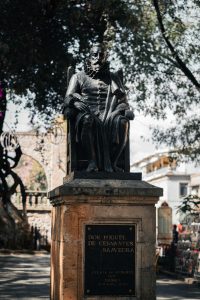
Don Quixote
By Miguel de Cervantes
The following is part of a series exploring classic books for people who always meant to read them, but never quite got around to it.
Introduction
Hello, and welcome. Today, you and I are going to step into the sunbaked heart of Old Spain, in the company of one of literature’s most enduring dreamers. The book is Don Quixote, penned by Miguel de Cervantes and first brought to the world in two parts, in 1605 and 1615. Cervantes, a soldier, tax collector, prisoner, and above all a storyteller, gave us a work that feels as lively and mischievous now as it did over four centuries ago.
You probably know a few scraps about Don Quixote already. Perhaps you picture a gaunt man in rusty armor, charging at windmills under the harsh Castilian sun. Maybe you remember a patient squire, Sancho Panza, bumping along beside him on a humble donkey. You might even recall the word “quixotic” – used for all those impossible, idealistic, and foolish quests. And yet, for all its fame, most people have never read the story all the way through. It’s no wonder; the novel is famously long, complex, and satirical. But don’t worry. Today, I’ll guide you through the adventures, misadventures, heartbreaks, and the laughter, in the spirit of Cervantes himself – for everyone who always meant to get around to it.
So, why does Don Quixote endure? Cervantes did something remarkable: with wit and warmth, he showed us the tragic hilarity of chasing our own dreams, set against a world often far too ordinary and hard-edged. Don Quixote is goofy and bewildering, then suddenly touching. The story moves from slapstick to philosophy with a few turns of the page, inviting you to reflect, to laugh, and maybe to sigh.
Don Quixote speaks to that daring and foolish impulse we all have – to chase wonder, to try to fix the world’s wrongs, even when it seems hopeless. As you listen, keep this in mind: at its heart, this novel is as much about loving stories as it is about living them. So, are you ready to enter the strange spaces where reality and fantasy rub shoulders? Let’s ride out on the dusty roads of La Mancha and meet the knight-errant whose shadow still reaches us all these centuries later.
Story Summary
Let’s begin where Cervantes does: in a small, nameless village on the plains of La Mancha, sometime in the late sixteenth century. There lives an aging gentleman named Alonso Quixano. He is not wealthy; his life is routine and comfortable, punctuated by simple meals and long hours spent reading. And what does he read? Chivalric romances – wild tales of knights and ladies, giants, wizards, and enchanted castles. These books intoxicate him. Over time, as Cervantes tells us, “his wits being quite gone,” Quixano is swallowed by these tales. He convinces himself that the past is not gone but only slumbering, waiting for a true knight to rise again.
So, Alonso Quixano does what seems ridiculous to everyone else, but absolutely necessary to him – he becomes Don Quixote de la Mancha, self-declared knight-errant. He repairs a suit of rusty armor that was his great-grandfather’s. He names his old, bony horse Rocinante, a name meant to sound noble. He gives himself a new identity, so he can set out to right wrongs and protect the defenseless. And what’s a knight without a lady? Quixote chooses a simple local farm girl, Aldonza Lorenzo, and renames her Dulcinea del Toboso. He worships her in absentia, transforming her (at least in his mind) into the most beautiful and virtuous lady in all of Spain.
The knight rides off for his first adventure – and immediately things unravel. In a nearby inn, which he believes to be a grand castle, Don Quixote insists that the bewildered innkeeper “dub” him a knight. The other guests – muleteers and serving women – egg him on, amused by his delusions. After a hilarious chaos of misunderstanding, he is “knighted” by the innkeeper, who wants nothing more than to get rid of the strange guest.
It isn’t long before Don Quixote’s escapades provoke trouble. He fights with mule-drivers, is battered and bruised, and comes home a mess. His friends, a kindly priest and the village barber, are alarmed. They resolve to cure him by burning his books of chivalry, blaming them for his madness. Quixote recovers for a while, but soon his mind turns back to adventure. And now he needs a companion, a faithful squire to join his travels.
Here enters Sancho Panza. Sancho is Quixote’s neighbor, a stout, earthy peasant with a wife and children, and very little experience with the world. The promise of an island to govern – just as squires sometimes received in the old romances – entices Sancho. He loves food and sleep, but is loyal and, in his blunt way, fond of Quixote. Sancho brings a practical eye and wisecracks to the strange partnership that soon becomes one of literature’s great double acts.
Quixote and Sancho set out together, and it isn’t long before they encounter the scene that has become an icon of Western culture: the attack on the windmills. Across the landscape, Quixote spies a field of enormous windmills and, squinting through the lens of his chivalric fantasies, sees towering giants threatening the countryside. “Fortune is guiding our affairs even better than we could have wished,” he cries. Sancho gently tries to correct him, but the knight will not be swayed. Charging with lance poised, Quixote is quickly thrown from Rocinante, battered by the turning sails of what are, unromantically, engines of flour – not monsters at all. Still, the knight holds tight to his delusion, chalking up defeat to “the enchanter who steals my victories,” a motif that will return again and again.
The story tumbles from one misadventure to the next. Along lonely roads and sunlit fields, Don Quixote looks for wrongs to right and people to save, but always seems to see the world not as it is, but as he’d like it to be. In an early episode, he mistakes a hapless group of merchants for knights and demands they confess that Dulcinea is the most beautiful lady in the world. Their ridicule provokes Quixote to attack, which ends with him lying sprawled in the dust, battered once again.
Sometimes, Quixote’s desire to help actually causes more harm than good. One day, he comes upon a boy being whipped by his master. Don Quixote intervenes with his sword and chivalric language, ordering the man to treat the boy kindly from then on. But as soon as Quixote leaves, the master punishes the boy even worse, and Quixote’s noble intentions crumble in the face of harsh reality. The world Quixote longs for, where gallant knights always win justice, simply does not exist.
And yet, for all his mishaps, Don Quixote never gives in to despair. Rather, he presses onward, always concocting new explanations for his failures. Perhaps wizards have conspired against him. Maybe evil enchanters disguise important people as commoners, or vice versa. If Quixote is defeated, it must be because fate, not folly, has tripped him up. And so Sancho Panza – half believing, half mocking – is swept along. His earthy proverbs and Quixote’s grand speeches intertwine, creating moments where wisdom and absurdity are hard to tell apart.
Sancho, for his part, is a fascinating character in his own right. He starts out gullible and greedy, dreaming of riches and governance, but grows more self-aware as the story advances. Still, his relationship with Quixote is deeply affectionate, part blind loyalty, part exasperated friendship. Throughout, Sancho’s hunger and homespun wisdom act as ballast to Quixote’s wild idealism.
As the pair wind their way through hills and villages, they meet all sorts of people: shepherds, innkeepers, priests, convicts, barbers, and even nobles. On more than one occasion, Sancho and Quixote get mixed up in local disputes and dramas, or force innocent bystanders into ridiculous situations. One day, for example, Quixote attacks a pair of friars traveling with a noblewoman, convinced they are enchanters carrying off a princess by force. Or the time he sets free a gang of galley slaves, who immediately turn on their liberators.
Cervantes uses these encounters to satirize the world around him. He pokes fun at Spanish society and ridicules the tradition of chivalric romances. At the same time, he evokes a kind of tenderness for his would-be knight, whose heart is in the right place, even if his head is full of clouds.
But these adventures are more than simple farce. Over time, the novel deepens, balancing Quixote’s madcap escapades with moments of genuine pathos. There’s sorrow in the way his dreams collide with untidy reality, just as there’s beauty in his constant refusal to accept cynicism. His faith is unshakeable – if unhinged. “When life itself seems lunatic, who knows where madness lies?” Cervantes seems to ask us.
Part One of the story culminates in an elaborate plan, hatched by Quixote’s friends. Convinced he’d be better at home, they decide to trick him back to the village. Disguised as magical figures, they convince Quixote he is under an enchantment and needs to return. And so, battered, hopeful, and mostly unchanged, Don Quixote comes home, to rest – until next time.
But that is not the end, for Cervantes returns with a much-anticipated sequel. The second half of Don Quixote finds our knight and squire set off once more. Word of their adventures has spread, and now everyone recognizes them. Some wish to help, others conspire to mock. The line between reality and fiction grows thinner, as characters have read the first part of Quixote’s saga; they scheme to trick, amuse, or reform him.
There are new adventures, and the humor grows richer and more self-aware. In one memorable episode, Don Quixote is welcomed to the home of the Duke and Duchess, wealthy aristocrats who have read of his exploits and decide to stage a series of elaborate pranks. They dress up servants as wizards and ladies, coax Sancho to govern a fictitious “island,” and engineer a mock flying horse made of wood. These scenes veer between ribald comedy and poignant longing, as Sancho briefly tastes the power he dreamed of and Quixote wrestles with the difference between stories and life itself.
The dynamic between Quixote and Sancho deepens. Over time, Sancho catches some of his master’s romantic spirit, while Quixote sometimes glimpses the wisdom in Sancho’s proverbs. Their companionship is marked by quarrels, reconciliations, and a loyalty that is touching. As Sancho learns to see the world with some of Don Quixote’s hopeful eyes, Quixote, in turn, recognizes the comfort of friendship and the sadness of being misunderstood.
Near the end of their journey, the adventures turn darker. Quixote is challenged to a duel by the Knight of the White Moon, who is, in fact, another villager hoping to cure him by force. After a hard fight, Quixote is forced to promise to abandon his quest and return home for a year. The magic and mischief of earlier pages give way to reflection and calm. Sancho, ever the loyal companion, stays at his side as health and hope drain away.
Back in his village, something changes. The enchantment of chivalry crumbles. Alonso Quixano awakens from his delusions, returns at last to his good sense, and quietly renounces his former “madness.” As death approaches, he asks forgiveness from his niece and friends. His last words are gentle, packed with resignation and affection. “I was mad, but I am so no longer,” he says, at peace. He leaves behind no riches or glory, but something perhaps greater – a legacy of wonder, humor, and the stubborn dream of a kinder, more magical world.
So there you have it: the battered knight who fought windmills, the wise-fool squire who believed in him, and a thousand small adventures that ripple through time. Cervantes’ Don Quixote is not just a parody, but also a serious meditation on aging, hope, failure, and the meanings we draw from stories. As Quixote’s life flickers out, we are left with laughter, a little sadness, and a lingering fondness for those who dare greatly, even when the world calls them mad.
Reflections and Themes
Don Quixote is a novel that keeps shifting, like sunlight across an old tiled floor. Its themes circle back on themselves, offering new insights depending on where you stand and what you bring to its pages.
At its heart, the book explores the tricky relationship between idealism and reality. Don Quixote is an extreme idealist, shaped and sometimes warped by the stories he loves. He wants to make the world better – to right wrongs, to restore chivalry, to see beauty everywhere. But each time he confronts the untidy facts of the world, he is bruised, mocked, and misunderstood. The tension between his dreams and the world’s limits raises a universal question: can one live nobly in a world that is often neither noble nor just?
Cervantes writes with both sympathy and skepticism. He shows how stories can heal and inspire, but can also tip us into folly. Quixote’s delusions are funny and sad, touching and infuriating. Yet, is he a fool, or a hero? You might find yourself rooting for his impossible quests, because we all, at one time or another, have wanted to believe in something larger than life. As Quixote exclaims, “When life itself seems lunatic, who knows where madness lies?” The lines between sense and nonsense are never fixed. The world needs its dreamers, even as it laughs at them.
The relationship between Don Quixote and Sancho Panza is another rich seam. Sancho begins as a simple realist, but through his adventures, finds himself changed. By journey’s end, Sancho believes in the possibility of Quixote’s dreams, even as Quixote lets go of them. Their friendship is a reminder that every grand quest needs both vision and grounding, that companionship can bridge the gap between fantasy and reality. In one of the novel’s tender moments, Sancho pleads with Quixote, “Let your worship take care how you set about these knight-errant pranks – for they are here and there, people that take them ill.” Through laughter and tears, their loyalty endures, even as their illusions fall away.
Satire is a blade that runs through the story. Cervantes pokes fun at the books that obsessed Quixote, at social pretensions, and at human folly itself. But it is never cruel. Humor and warmth carry the reader along, inviting us to laugh but never to turn away in scorn. The absurdity of attacking windmills, the endless pile-up of bruises and pratfalls – these are reminders that everyone is out of step now and then, especially when chasing a heartfelt dream. The most famous scene, still echoing through centuries, shows Don Quixote tilting at windmills, which he sees as giants. When knocked down, he declares, “They were turned into windmills by magic.” He never gives up hope, even in the face of defeat.
For older adults, there is another resonance here: the idea of aging and reflection. Don Quixote is not a youth, but a man passing his prime, searching for meaning and purpose. The battles are not just against giants, but against time itself. The novel looks at how we age, how our hopes shift, and how we measure our failures and achievements. In the closing lines, Quixote’s renunciation of chivalry is both a sad acceptance and a quiet triumph of self-knowledge.
Cervantes also explores the power – and the limits – of fiction. The characters literally become famous inside their own story, which raises questions about what is true and what is made-up. The second part of the novel glances slyly at the role of readers and writers, blurring the edges between imagination and reality. In this way, Don Quixote stands as the first “modern” novel, endlessly self-aware and always playing with expectations.
Perhaps most lastingly, Don Quixote reminds us that to be human is to live between what is, and what might be. We may fail, look foolish, or even lose our minds chasing dreams. But sometimes, as Cervantes suggests, a little madness is the price of hope. As Don Quixote himself puts it, “Too much sanity may be madness – and maddest of all, to see life as it is and not as it should be.”
Closing
As we leave the winding roads of La Mancha behind, take a moment to reflect on the unlikely knight and his steadfast squire. Don Quixote’s armor was never truly polished, his battles never grand, and his fantasies never quite lined up with the world around him. Yet in his impossible quest, he found meaning, friendship, laughter, and yes, even love. Sancho Panza, with his loyal heart and knack for speaking plain truth cloaked in proverbs, reminds us that the journey matters as much as the destination – perhaps even more.
These are the gifts Cervantes leaves behind: the courage to hope, to risk foolishness for something beautiful, and to share the journey with friends who meet us halfway. Don Quixote’s tale is a gentle nudge – that age, disappointment, or mockery can never quite rub the shine off dreams. Whether you have spent a lifetime reading or just a few moments listening today, know that the story belongs to you now. Would you, given the chance, follow your heart down the dusty lane, tilting at your own windmills?
This has been The Book You Never Read — the story you always meant to read, now you have finally caught up.
About This Book
- Author description: Miguel de Cervantes was a Spanish novelist, playwright, and poet whose enduring masterpiece, Don Quixote, is widely regarded as the first modern novel. His humor, humanity, and insight shaped the course of Western literature.
- Source: Don Quixote by Miguel de Cervantes, available at https://www.gutenberg.org/ebooks/996