
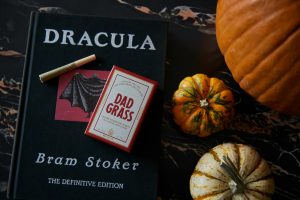
Dracula
By Bram Stoker
The following is part of a series exploring classic books for people who always meant to read them, but never quite got around to it.
Introduction
Welcome. Today, let’s step into the haunting shadow of one of the most iconic stories ever told. We’re about to journey through Dracula, the unforgettable 1897 novel penned by Bram Stoker. You may already know its title, whispered across popular culture for more than a century, but its beating heart and flickering candlelit corners still hold surprises for even the most world-wise among us.
Bram Stoker was an Irish writer, theater manager, and lifelong lover of folklore. When he released Dracula near the turn of the twentieth century, he gathered threads of horror, romance, and superstition into one unforgettable tapestry. This is not just a story of a vampire. It’s also the tale of courage, friendship, and the inner struggles we face in the dark. More than a century later, its echoes can be heard in everything from films to Halloween costumes, and yet so many of us have never truly entered the swirling mists of the original tale.
Why is Dracula still worth reading? An old castle perched above shadowy forests, a creature who slips through keyholes in the night, and a group of ordinary people drawn into an extraordinary battle – these are images that stay with us. Beyond the chills and fangs, Stoker’s novel grapples with fear and hope, faith and doubt, love, loss, and the struggle against unstoppable change. It’s a book of letters and diaries, giving voice to a whole chorus of characters as they cross paths and destinies. There’s adventure, heartache, and a kind of restless humanity that’s as much about the anxieties of Stoker’s era as our own.
But who, really, is Count Dracula? And how did a simple solicitor’s visit to Transylvania spiral into a race against time – one that pits science against superstition, and resilience against utter terror? The pages are as much about holding together in the face of unspeakable evil as they are about capes and castles. So, if you’ve always pictured Dracula as an old movie villain, I invite you to see the original creature in all his subtlety and menace.
We’re about to unravel the story behind the legend, one creeping shadow at a time.
Story Summary
Imagine it is the last days of April, in the final years of the 19th century. You are Jonathan Harker, a diligent and young English solicitor, setting off by train and carriage from London into the furthest reaches of Eastern Europe. Your destination is deep in the Carpathian Mountains of Transylvania. Your task is simple: assist Count Dracula with the final legalities of purchasing a home in England.
The journey begins with the clatter of wheels, each town stranger and more superstitious than the last. At every step, the locals grow visibly anxious at the mere mention of Dracula’s name. They whisper warnings, press crucifixes into your hand, and beg you not to go on. But you, good-hearted and rational, are determined. The world, after all, is full of superstition and local legend. Isn’t it?
At last, a moonlit coach draws you through winding mountain passes to Castle Dracula itself. A door creaks open, a strange pale figure greets you. He is dressed all in black, with a voice that seems to echo from stone. This, at last, is Count Dracula. He is unfailingly polite, yet everything about him seems sharpened and perilous. Harker writes in his journal: “The Count’s courtesies were so perfect, that I could not but feel myself in some measure at ease.”
Jonathon Harker gradually realizes that he is, in truth, a prisoner. The Count never eats, seldom appears except at night, and moves with uncanny grace. There are no mirrors. Wolves howl beneath the windows. Every morning, your host locks every door. Stranger still, Harker catches glimpses of the Count climbing the castle walls, as easily as a lizard, defying every natural law.
The tension mounts when Harker, out of curiosity and desperation, explores farther into the castle. In a chilling night-time episode, he is approached by three beautiful, unnaturally pale women – the infamous Brides of Dracula. Their lips part in hunger, and only Dracula’s sudden arrival saves his life. “This man belongs to me!” the Count declares angrily, sending the women away. It is a moment that leaves Harker shaken to the core, realizing his very survival depends on Dracula’s peculiar will.
Meanwhile, hundreds of miles away in England, Harker’s fiancée Mina Murray pens letters to her dear friend, Lucy Westenra. Lucy is a sweet, gentle soul – beloved by three suitors: Dr. John Seward, the loyal and reserved physician; the Americans Quincey Morris, brave and practical; and Arthur Holmwood, a thoughtful and deeply caring man whom Lucy finally accepts. Their letters blend hope with ordinary concerns, blissfully unaware of the dark fate moving toward them across the sea.
Back in Transylvania, Harker discovers Dracula’s genuine intention. Hidden in forbidden rooms are crates filled with soil – “boxes of earth”. Dracula is preparing to leave for England, bringing his native earth to rest in during the day. Trapped and desperate, Jonathan attempts a dangerous escape, scaling the castle walls. Whether he survives is left uncertain, as the narrative shifts.
We leap over the continent, where a mysterious ship, the Demeter, arrives in the coastal town of Whitby, dashed upon the rocks in a violent storm. All its crew are missing. Only the captain is found, lashed to the wheel, a crucifix clutched in frozen hands. There is talk of a monstrous black dog leaping ashore amidst the surf. Local residents, including Mina and Lucy, are drawn to the wreck, unaware that the cargo includes boxes of earth – and the Count himself, now free upon English soil.
Lucy’s health soon begins to falter. She develops strange sleepwalking episodes and persistent faintness. Mina, ever the steady friend, watches over her. On a night thick with fog, Mina follows Lucy, unwittingly witness to a shadowy figure bending over her friend on a cliff’s edge. Lucy’s neck bears strange, inexplicable wounds. The sense of dread grows stronger, even as the women try to explain it away by common ailments.
With Lucy steadily declining, Dr. Seward calls for the renowned Professor Abraham Van Helsing. Van Helsing, wise and enigmatic, quickly suspects something far outside ordinary medicine. He prescribes blood transfusions – from Arthur, Quincey, Seward himself – but Lucy continues to waste away. Large, white blooms are fastened around the room, and fresh garlic adorns Lucy’s neck by night. It is an odd, almost comical scene to English eyes, but Van Helsing is deadly serious. He warns, “It is the fault of science that it wants to explain all; and if it explain not, then it says there is nothing to explain.”
Despite these efforts, tragedy strikes. Lucy succumbs to her mysterious illness. The grief is raw and consuming. Yet Van Helsing remains vigilant. Soon, children of the town begin to recount tales of a “bloofer lady” luring them in the graveyard. Van Helsing and Lucy’s suitors exhume her grave, discovering she has transformed into a vampire herself. She is both beautiful and monstrous in death. With heavy hearts, her loved ones release her soul in a spine-tingling scene, driving a stake through her heart. It is an act of mercy and finality, though it shakes each man to his core.
Meanwhile, Jonathan Harker is found alive in Budapest, delirious but safe. He and Mina are married, reunited at last. As the couple returns to England, they bring with them Harker’s harrowing journal entries. Van Helsing, seeing these notes, begins to weave the scattered truths together. Mina, sharp and resourceful, gathers all the letters, diaries, and observations from the group, assembling them like puzzle pieces. Suddenly, the faint outlines of Dracula’s movement through London become clear.
The pace quickens. At Carfax Abbey, the rambling property Dracula has purchased, signs of his presence are unmistakable. With cunning and quiet power, he moves through the city night by night, preying upon the innocent and stirring panic. Dr. Seward’s asylum, which neighbors Carfax, is soon caught in the whirl. One of his patients, the strange and pitiful Renfield, exhibits wild moods and obsessions. Renfield is drawn to devouring flies, spiders, and birds, longing for “life” in its smallest forms. He is, it becomes tragically clear, under Dracula’s sway – a living echo of the Count’s parasitic craving.
As the circle tightens, Mina herself is threatened. She is lured, night after night, into a trance, compelled by Dracula’s will. On a stormy night, the group catches the fiend in the act – bent over Mina as she sleeps. In a horrific tableau, they glimpse Dracula forcing Mina to drink from a wound on his bare chest, binding her to him in both body and spirit. Mina awakens, horrified and marked. Van Helsing explains, sober and compassionate, that she is now “unclean”, irrevocably bound to Dracula. Still, he swears, where there is life, there is hope.
The friends unite, determined to destroy Dracula before Mina is lost forever. They hunt down and purify the earth-filled boxes that Dracula uses to rest by day, cutting off his options one by one. It is a methodical, desperate game – knowledge against cunning, the stakes measured not just in lives, but souls. Mina, increasingly caught in the vampire’s psychic thrall, becomes both a guide and a victim. At times, she can “sense” Dracula’s whereabouts, helping the group track him. But the connection is a double-edged sword, and her worsening condition keeps everyone on edge.
The chase leads them first through the dark alleys of London, then across stormy seas and rivers. Dracula, sensing defeat, flees homeward to Transylvania. There is something almost mythic in this pursuit – six weary but fiercely loyal companions, racing time itself across Europe, up tangled rivers and into the bleak Carpathian mountains. There are echoes here of age-old quests and loyalty, of the determination to save what must be saved, no matter the cost.
In Transylvania, winter approaches. The group faces howling wolves, hostile peasants, and biting cold. They intercept Dracula’s helpers and finally, at dusk on a snowy mountain pass, confront the Count’s remaining loyalists just as they deliver his earth-filled box to the castle. It is Quincey Morris who, mortally wounded in the struggle, delivers the final blow. Even as the sun dips and the odds seem against them, the group opens the box, and Jonathan Harker’s blade cuts through Dracula’s neck as Quincey drives his knife into the heart. The Count’s body crumbles to dust, and, with a look of peace, Mina is released from his spell.
The story closes with heartfelt loss and lasting friendship. From the first trembling steps into the foggy Transylvanian woods to the final daybreak on the mountain pass, you can feel the jagged mixture of fear, loyalty, and exhausted relief. Quincey dies a hero, clasped in friendship, far from home. The remaining friends gather, changed but grateful, forever bonded by what they have survived.
Years later, Jonathan and Mina have a son, named after their brave companions. The records they kept, bound together and stored with loving care, ensure that the truth is remembered. In the words of Mina, “We want no proofs; we ask none to believe us! This boy will some day know what a brave and gallant woman his mother is.” And so their story follows us too, long after the last page.
Reflections and Themes
Dracula is famous for its monsters and shadows, but at its core, the novel is about the resilience of ordinary people when events turn extraordinary. Each character – whether Jonathan Harker facing nightmares alone, or Mina rallying the group through her own suffering – demonstrates the quieter heroism of steadfastness, hope, and compassion. The story shows how fear can bind and isolate, but even more, how loyalty and friendship can dispel the darkest night.
One theme that resonates is how humans face the unknown. For Stoker’s original readers, Dracula symbolized the strange and unsettling changes of a new era: new technologies arriving daily, old beliefs colliding with modern science. Some characters put their faith in reason and medicine; others yield to folklore and instinct. Professor Van Helsing bridges these worlds, holding up both crucifix and scalpel, using garlic and transfusions alike. He reminds us, “We learn from failure, not from success!” It is a lesson that applies both in the story and beyond its pages.
The power of collaboration also runs strong in these pages. Everyone, at some point, falters – but the group carries on together. Friendship, love, and the willingness to act in the face of danger become the real weapons against darkness. When Lucy falls, those who loved her rise to the task she cannot finish. When Mina is infected, it is her own intelligence and courage – as well as the group’s refusal to give up on her – that wins the day.
There’s an undercurrent of loss, too: of innocence, of safety, of loved ones. The joy of living carries with it the reality that we must sometimes struggle, and even say goodbye. But here, grief also becomes a call to action, a fuel for bravery. Even the tragic Lucy is ultimately remembered as more than a victim, but as a beloved soul whose ordeal brings out the best in others.
Stoker’s use of diaries and letters echoes the ways we try to make sense of the world – gathering bits and pieces, bringing order to the chaos. It is not always enough to banish evil completely, but it is how understanding is built and remembered. Van Helsing’s wisdom, shared near the end, captures this duality: “It is a strange world, a sad world, a world full of miseries, and woes, and troubles; and yet when King Laugh come he make them all dance to the tune he play. Bleeding hearts, and dry bones of the churchyard, and tears that burn as they fall – all dance together to the music of his laughter.”
For those reflecting on their own lives, perhaps there is a quiet lesson in these pages. There are always new fears, and sometimes the world feels full of ancient secrets or modern troubles. But courage is often simply the willingness to persevere, to hold a friend’s hand, or to write things down, so that knowledge and connection endure. The final hope of Dracula is that light can always return, as long as even a small group of people refuse to let darkness have the last word.
Closing
As we step back from the howling wolves and dusty crypts of Dracula, it is clear why this novel has haunted our imagination for so long. It is not just about monsters or moonlit castles, but about our shared journeys through confusion, loss, and bravery. Bram Stoker’s world is more than superstition; it is a testament to the ways people come together in adversity, and the way love – in all its forms – persists in the face of the unknown.
Perhaps the real question Dracula asks us is not whether we believe in vampires, but how we respond when the unthinkable arrives at our doorstep. Will we stand together, share what we know, and do our best to hold back the darkness for another day? Its legacy endures not because evil is ever truly vanquished, but because every small act of courage matters. The story you always meant to read is one of endurance, memory, and the hope that dawn always comes, no matter how long the night.
This has been The Book You Never Read — the story you always meant to read, now you have finally caught up.
About This Book
- Author description: Bram Stoker was an Irish novelist and theater manager, best remembered for creating the enduring figure of Count Dracula and leaving a lasting mark on the world of horror fiction.
- Source: Dracula by Bram Stoker, available at https://www.gutenberg.org/ebooks/345