
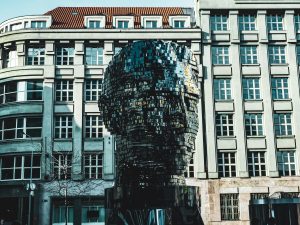
Metamorphosis
By Franz Kafka
The following is part of a series exploring classic books for people who always meant to read them, but never quite got around to it.
Introduction
Welcome to another journey through a literary classic – today, let’s step into the unforgettable world of Metamorphosis by Franz Kafka. Published in 1915, this short novel has bewitched and puzzled generations of readers with its haunting story and deeply human questions. Kafka, a German-speaking Bohemian writer born in Prague, crafted this tale at the height of modernism. His writing continues to echo in our contemporary world and reaches across time, culture, and circumstance.
Even if you’ve never read Kafka before, his name might already stir a feeling of mystery or unease. To call a situation “Kafkaesque” is to invoke a sense of bureaucratic absurdity, helplessness, and dreamlike dislocation from reality. But what exactly does that mean? And what is it about Metamorphosis that has comforted, startled, and moved so many, for over a century?
The story is famously simple on its surface. One morning, an ordinary traveling salesman named Gregor Samsa wakes up and discovers he has been transformed into… something monstrous. The first line is as direct as it is jarring: “When Gregor Samsa woke from troubled dreams one morning, he found he had been transformed in his bed into a monstrous insect.” It’s a beginning that feels both incredibly strange and strangely familiar, laying bare a fear at the root of so many anxieties—what if, overnight, we were no longer who we once were?
Metamorphosis endures because it’s about more than just a shocking transformation. It’s a parable about family, duty, the search for understanding, and the longing for belonging. It asks us to look at loneliness, love, and the ways we change with time and circumstance. In only a few hours, you can experience an entire lifetime of feeling through Gregor’s unusual predicament.
So, what is the true secret at the heart of Gregor Samsa’s story? What becomes of a family when the unimaginable happens, and who are we—really—when everything familiar falls away? Let’s begin, and trace Gregor’s strange, moving journey from the first morning of his change to its quietly shattering conclusion.
Story Summary
Let’s imagine it’s another gray morning in early twentieth-century Prague, a city where old and new rub together uneasily. In a modest, middle-class apartment, Gregor Samsa awakens from nightmares—only to discover he has changed into a gigantic insect. Kafka never tells us exactly what kind, but Gregor’s new form is daunting: a hard, curved back, many thin legs, a body utterly foreign to anything human.
Gregor lies in bed for a while, confused and oddly calm despite his predicament. We quickly see his character emerge; his first thoughts are not for himself, but for his family and his job. Gregor is the breadwinner, a traveling salesman who supports his parents and younger sister, Grete. He’s already worried that he’s late for his train and what his boss will say if he doesn’t show up. The transformation shocks him, yes, but the routines and pressures of work and family hold him even tighter.
That sense of duty defines Gregor. Kafka writes, “What an exhausting job I’ve picked! Day in, day out—on the road. It’s much more stressful than the work at headquarters, and, besides, I have to deal with the problems of traveling, the worries about train connections, the irregular, bad meals, new people all the time, no continuity, no affection.” Even as an insect, Gregor tries to reassure himself and, through sheer force of will, pushes to get out of bed. His thoughts spiral—if he can just get up, maybe he can go to work, maybe no one will notice anything is amiss.
As Gregor struggles futilely to maneuver his new body, his family begins to worry in the hallway outside his door. They call to him, encourage him, and scold him for being late. His mother and sister’s voices are tender at first, then increasingly anxious, while his father’s concern is firm, bordering on sternness. The household depends utterly on Gregor’s wages. The idea that he might be unable to fulfill this role throws the entire family into panic.
While Gregor fumbles awkwardly trying to unlock his bedroom door with his unfamiliar limbs, the chief clerk from his firm arrives at the apartment. You can almost picture the poor man’s discomfort even before he knows what has happened – he is the embodiment of outside authority: quick to reprimand, full of suspicion, and clearly lacking in kindness. He suspects Gregor of slacking off. Only when Gregor finally opens the door, revealing himself in full insect form, do the reactions escalate to shock and chaos.
In this moment, we feel a strange combination of horror and compassion. The clerk recoils, the mother faints, and the father – after an initial paralysis – drives Gregor back into his room with a walking stick and a rolled newspaper. The family shuts him away, terrified and unable to process what they have seen. This marks the first great shift. Gregor, who once shouldered all of his family’s burdens, is now shut out of their ordinary lives, treated as something other, something dangerous and pitiful.
Inside his room, Gregor becomes steadily more insectlike, losing his taste for human food and growing accustomed to crawling on the walls and ceiling. Despite everything, his human feelings linger. His mind remains sharp, tender, ready to worry for his family and remember past dreams. In his new state, he observes his loved ones through a crack in the door, watching them adapt and reorganize in the face of his sudden helplessness.
Grete, Gregor’s sister, emerges as an unlikely ally. Though frightened, she alone dares to enter his room each day, bringing scraps of food and gingerly swapping out what he hasn’t touched. She even removes some of the furniture to give him space to crawl more easily. These small acts of care speak volumes about her struggle. She cannot speak to her brother; she is repulsed by the sight of him. But she persists, driven by memory and duty, performing an act of quiet, awkward kindness.
Gregor’s mother, meanwhile, is torn apart by grief and guilt. She wants desperately to see her son, to believe a part of him remains. At one point, she enters his room to help Grete move furniture, suggesting they leave at least a few familiar objects for Gregor’s sake. “Won’t it seem as if we’re showing that we’re giving up all hope of his getting better if we take away all the furniture?” she pleads. But even here, terror triumphs over hope. The simple act of witnessing Gregor in his insect form proves too much, and she collapses in distress.
Gregor’s father is a powerful, complicated figure. Once forced into retirement, passive and broken by misfortune, he has found new energy, spurred on by the crisis. He dons a uniform, finds work as a bank porter, and resumes authority over the household. Yet when he encounters Gregor, the result is violence – a rain of apples from his father’s hand, one of which wounds Gregor deeply, lodging in his back and causing a festering, painful injury that never heals. It’s a symbolic moment, this act of aggression from father to son – a failed attempt to master fear through force.
As weeks pass, the family adapts to a new rhythm. Gregor becomes increasingly isolated, eavesdropping from his room, longing for conversation, but ultimately made aware that his presence is a burden, a secret shame. The Samsa family, once dependent on Gregor, find work and take in boarders to meet expenses. Each finds roles and routines; even Grete, once his champion, begins to see her brother less as a relative and more as an obstacle.
One of the most telling scenes arrives when the family hosts three unnamed lodgers, stern and meticulous men from the outside world. Grete plays violin for them after dinner, hoping for recognition. Gregor, still moved by his sister’s playing, emerges from his room, drawn helplessly to the music. In a poignant, tragic moment, he listens longingly, thinking, “Was he an animal if music could move him so?” In his longing for beauty and connection, Gregor tumbles into the light, utterly exposed.
The boarders are horrified. They threaten to leave, and in their outrage, assign blame squarely on the family. Here, the final threads of sympathy snap. Grete, exhausted and hardened, tells her parents, “We have to try and get rid of it.” She refers to Gregor not as a brother, but only as an “it.” For Gregor, this is the most devastating blow of all. Even his last defender can no longer see the human being beneath the insect shell.
That night, wounded and heartbroken, Gregor slips away quietly. Alone in his room, thinking of his family, he moves for the last time. “He thought back on his family with deep emotion and love. His own conviction that he must disappear was, if possible, even firmer than his sister’s.” With that, Gregor dies, his body discovered the next morning by the family’s cleaning woman.
The aftermath is swift. The family feels real grief, but also an immense sense of relief, as if a great cloud has passed. They leave their apartment, take a tram, and venture out into the sunshine, discussing plans for a brighter future. The story closes not with Gregor, but with his family – released from their burden, uttering a sigh that is equal parts sorrow and renewal.
Through every scene, Kafka invites us to live inside Gregor’s skin – to feel the confusion, the yearning, the trapped, trembling love that persists even after the world no longer sees us as ourselves. We watch as the Samsa family navigates shifting roles, try to care, and ultimately must accept the transformation life has thrust upon them. What at first seems a tale of horror becomes, in its heart, a meditation on how love twists under pressure, and how identity can slip through the cracks even among those who know us best.
The city outside is gray and distant, the workplace a cipher, the home itself full of shadows and corners. And in each moment, there hovers the question: How do we respond when someone close to us changes beyond understanding? Do we reach for them, or draw away? Where does our compassion end – and what does it cost us to keep trying? Kafka manages to make even the most surreal horror painfully intimate, drawing us face-to-face with the limits of self, family, and hope.
The power of Metamorphosis doesn’t rest in spectacle or solutions. Instead, Kafka lingers on the moments of awkward silence, the gestures of care that get tangled up in grief, and the little indignities that accumulate until we are changed by them. In Gregor’s story, we see a whole family’s transformation, not just his own.
If you let yourself walk alongside Gregor and the Samsas for these brief, difficult days, you’ll find that beneath the oddity is something deeply recognizable: the sorrow of being misunderstood, the ache to matter, the resilience of love, and the quiet knowledge that nothing stays the same forever.
In the end, Gregor’s journey is not simply his own. It is the story of all of us, at the moments when we most need understanding, and when those we love do not know how to give it.
Reflections and Themes
Stepping back from the events of Metamorphosis, many readers still find themselves haunted by the story. What exactly is Kafka telling us through Gregor Samsa’s ordeal? On its surface, it’s a tale of the grotesque and bizarre, but beneath that, it’s a quiet, deeply human meditation on change, alienation, and the limits of empathy.
One of the central questions of the novel is how families and societies respond when someone changes beyond recognition. Gregor’s transformation is sudden and absolute, but Kafka doesn’t focus on the spectacle. Instead, he peers closely at what happens afterward—the awkward caregiving, the whispered conversations behind closed doors, the unbearable silence when words fail. The initial outbursts of sympathy and hope gradually give way to resentment, frustration, and, finally, disengagement.
Many older readers recognize these feelings. Perhaps you’ve cared for someone whose circumstances altered suddenly, or maybe you’ve felt yourself “morphing” as life delivers hardships or unexpected turns. In Gregor’s desperate bid for understanding and his family’s shifting loyalties, we see the contours of real-life struggles—chronic illness, aging, loss, or simply those moments when our identity is at odds with what we once were.
Kafka was writing at a time when the world was changing rapidly—politically, socially, technologically. Underneath Gregor’s tragic predicament is a more universal anxiety: What is my worth if I can no longer work? What happens when the world no longer needs, notices, or welcomes me? Through Gregor’s silent watching and Grete’s clumsy compassion, Kafka explores what it means to be truly seen by others, and what it feels like when that gaze falters.
Consider the way Kafka describes Gregor’s persistent inner life, even after his monstrous change: “Was he an animal, if music could move him so?” Despite his new body, Gregor’s longing for connection, for beauty, and for meaning never disappears. This is a touching reminder that a person’s value continues, regardless of outward changes. Gregor doesn’t lose his humanity—his family loses sight of it.
The story is also deeply concerned with the bonds and burdens of caregiving. Grete tries her best, at first, to help her brother. Yet over time, the daily pressure drains her patience and love. Kafka doesn’t judge her; instead, he shines a gentle light on her exhaustion, culminating in the painful moment when she declares, “We have to try and get rid of it.” It’s a perfectly honest, if devastating, response to compassion stretched beyond its limit.
The story’s conclusion may seem bleak, but there’s a subtle hope flickering at its edges. After Gregor’s passing, the family steps out into the world again. They are changed, yes, but not entirely broken by their ordeal. Some readers see in that tram ride—a family, together, facing the uncertain sunlight—a tentative sign of healing. Others may feel a quiet rage at the ease with which Gregor is forgotten. Kafka’s genius lies in leaving room for both emotions.
For anyone in retirement or later life, Metamorphosis invites big questions about change—how we weather it, what we owe each other, and what remains after everything else falls away. Aging, illness, grief, and shifting family roles are themes that pulse quietly through every page.
Perhaps that’s why Kafka’s slender, strange novel still matters. The way he describes Gregor’s quiet withdrawal, the family’s desperate attempts to mend and rationalize, and the world’s indifference to individual suffering—all feel as true now as they did over a century ago. When he writes, “He thought back on his family with deep emotion and love,” we glimpse the story’s lasting message: Even in the face of transformation and loss, what counts most is the persistence of love, however awkward or incomplete.
As you reflect on Gregor’s story, you might ask yourself: How do we honor the dignity of those who’ve changed? How can we meet the strangeness of life with something other than fear? Metamorphosis won’t give you sharp answers, but it will help you ask the right questions, with honesty, humility, and maybe—just maybe—a glimmer of courage.
Closing
So, as we close the book on Gregor Samsa’s strange, unforgettable journey, let’s carry forward the quiet lessons tucked between Kafka’s lines. Whether we feel like caregivers, bystanders, or those undergoing change ourselves, we all know what it means to long for understanding—to hunger for connection even when words fail and roles shift.
Metamorphosis lingers, not just for its striking premise, but for its gentle, unflinching honesty about the ways that life changes us, sometimes overnight. It’s a reminder that, above all, to be seen and cared for in moments of vulnerability is both our greatest hope and our hardest challenge. If you ever feared that transformation would leave you all alone, Kafka’s story assures you: in the shadows of change, love and memory still flicker, keeping something precious alive.
Maybe the next time someone in your life faces the unimaginable, or you find yourself changed in unexpected ways, you’ll recall Gregor’s plight and the peculiar, fragile bonds that held his family together even through heartbreak. Kafka’s world might be uncanny, but it is, at its core, achingly real.
This has been The Book You Never Read — the story you always meant to read, now you have finally caught up.
About This Book
- Author description: Franz Kafka (1883-1924) was a Bohemian novelist and short story writer whose works famously explore themes of isolation, alienation, and the surreal challenges of modern life.
- Source: Metamorphosis by Franz Kafka, available at https://www.gutenberg.org/ebooks/5200